


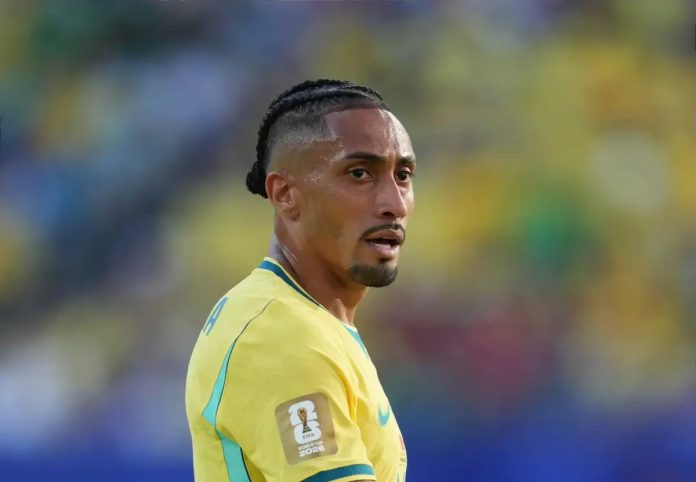
Alarm in Barcelona and Brazil: winger Raphinha was seen training separately from the rest of the squad following the demanding 1-1 draw against Morocco at the start of the World Cup, fueling immediate speculation about a possible injury and causing concern among fans and officials. However, information released on Monday reveals that the decision to remove the Brazilian international from high-intensity exercises is not due to any physical issue, but rather a strategy for managing workload outlined by the national team’s coaching staff.
Raphinha, a key player for both Barcelona and Brazil, did not participate with the same intensity as his teammates in the training session held at Columbia Park in Morristown, following the inaugural draw. The Brazilian winger was excluded from the more demanding exercises, a fact that quickly went viral and led many to fear the worst, especially considering the images of the player completely exhausted after the match against Morocco, where he was seen collapsing on the pitch after a total sacrifice performance over the 90 minutes.
The World Cup is experienced with LEGO.
Despite the concern generated, the Brazilian Football Confederation (CBF) hastened to reassure fans and the media, clarifying that Raphinha’s absence from the more intense training sessions was purely preventive. “The decision was entirely preventive. The goal is to keep the key players fresh and available for the upcoming challenges of the World Cup,” an official CBF source confirmed on Monday afternoon, emphasizing that there are no injuries to report.
This precautionary plan did not only apply to Raphinha. Midfielder Bruno Guimarães and defender Gabriel Magalhães were also subjected to an individualized regime, joining the pitch a few minutes after the main group to perform lower-intensity exercises designed to minimize accumulated physical fatigue. The Brazilian coaching staff, aware of the density and demands of the schedule, chose not to take risks with three of their most valuable assets, in a clear attempt to avoid injuries that could jeopardize the team’s progress in the competition.
The context could not be more delicate: after a bittersweet draw against Morocco, where Raphinha was one of the most restless players on the field, the pressure to ensure maximum physical availability of the starters is enormous. The Barcelona forward proved tireless during the match, finishing the game in evident exhaustion, which justified, in the eyes of the coaching staff, the temporary easing of the workload. “It was a performance of immense commitment. We prefer not to take risks and manage the effort, especially at this early stage of the tournament,” explained a member of the medical department of the Brazilian national team, emphasizing that the priority is to ensure the presence of the stars in decisive moments.
This episode, however, raises some pertinent questions about the physical condition of Raphinha and other key players for Brazil. Will the accumulated fatigue affect the team’s performance in the upcoming matches? Is the Barcelona winger in ideal condition to take the lead against tougher opponents in the next phase? For now, the response from the coaching staff is one of calm and confidence, but the careful management of these athletes will be crucial for Brazil’s ambitions in this World Cup.
The next match is already critical for the group’s standings, and all eyes will be on Raphinha, whose physical condition will be closely monitored until the initial whistle. If the prevention plan works as expected, the winger should return at full strength and ready to make an impact, both for the national team and later upon returning to Barcelona. However, the margin for error is minimal, and any signs of physical fragility could lead to controversies and fierce criticism, especially in a World Cup context, where pressure and expectations reach their peak.
NOW YOU CAN FOLLOW THE WORLD CUP WITH ALL THE INFORMATION – HERE
Discover more from Apito Final
Subscribe to get the latest posts sent to your email.

