


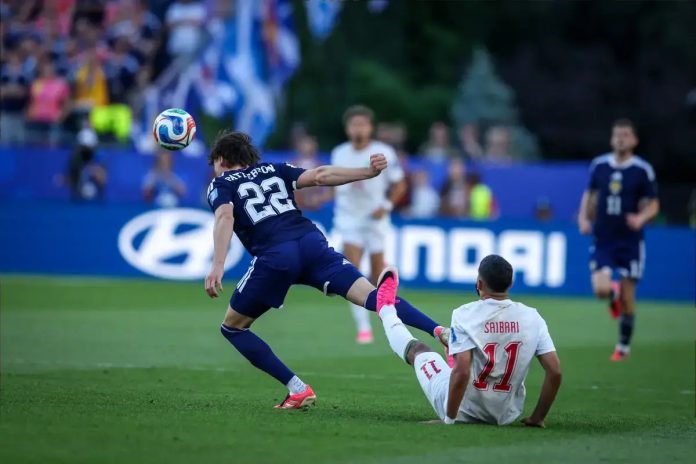
Scandal in Boston: Scotland saw two major penalties go unawarded and an opponent escape expulsion in one of the most controversial matches of this World Cup. The 1-0 defeat to Morocco, marked by controversial refereeing decisions, is igniting debate and outraging fans, former internationals, and analysts, who believe that Steve Clarke’s team was severely disadvantaged.
The match took place in Boston, where Scotland, after winning against Haiti 1-0 in the opening match, sought to consolidate its position in the group. However, everything started in the worst possible way: Ismael Saibari put Morocco ahead just 70 seconds into the game, leaving the Scots at a disadvantage and at the mercy of an officiating that quickly became a focal point. Throughout the match, Scotland appealed for two penalties, both in the second half, after John McGinn and Scott McTominay were brought down in the area. To exacerbate the outrage, Moroccan defender Issa Diop received only a yellow card after stopping Che Adams when he was clear on goal.

THE 2026 WORLD CUP IS EXPERIENCED WITH LEGO
This scenario raises serious questions about the fairness of the outcome and the impact of refereeing decisions in this World Cup. In a campaign where Scotland is trying to overcome its history of early exits, the frustration of feeling wronged could have psychological and competitive consequences. The absence of penalties and the non-expulsion of Diop may have completely altered the course of the match, depriving Scotland of the opportunity to contest the result on equal terms. In the broader context of the competition, such controversies raise alarms about the referees’ criteria and the role of VAR, placing additional pressure on FIFA and the officiating team.
Reactions were swift and varied, both on and off the pitch. Former referee Christina Unkel, commenting for ITV, had no doubts: “I think it’s a penalty,” she said regarding the McTominay incident, arguing that “the referee is known for allowing a higher level of physicality, but it doesn’t take much to call a penalty. It’s a simple foul, there’s contact at knee level and another angle suggests there may have been a stamp on the left foot.” On the other hand, Roy Keane and Ange Postecoglou, also present on the ITV panel, disagreed and defended the referee’s decisions.
Steve Clarke, manager of Scotland, adopted a diplomatic tone but did not hide his discomfort: “There were one or two decisions I’m not sure about. I thought the one on John McGinn was more of a penalty than the one on Scott McTominay. On another day, someone might have given it. It’s the same with the yellow card for the defender when Che Adams is through on goal. On another day, that could be a red.” These words reveal a sense of injustice and the consideration that, under different circumstances, the outcome could have been different.
John McGinn himself left no doubt about what he felt on the pitch. “We could have been helped by the referee on some 50-50 calls. I have no problem letting the game flow, but there has to be consistency. I saw the Moroccan defender coming in from the corner of my eye. I got to the ball first and he brought me down. For me, it’s a penalty. Sometimes they give it, sometimes they don’t. If it had been called on the field, it wouldn’t have been overturned. Morocco got away with that one. But we have to do better, create goal-scoring opportunities in open play and not rely on the referee’s decisions,” said the Aston Villa midfielder.
The incident involving Diop also sparked strong reactions. Neil McCann, former forward and current manager of Kilmarnock, was unequivocal: “For me, it’s a red card. Che Adams is in an advantageous position and is clearly pulled down. With the trajectory of the ball, he was going to get there and there was no one covering. It’s a clear goal-scoring opportunity.” James McFadden corroborated: “He is running towards the goal, in the direction of the net. It is undoubtedly a clear goal-scoring opportunity. If the referee considers it a foul, he has to send him off.” In contrast, Pat Nevin, former Scotland winger, defended the performance of Uzbek referee Ilgiz Tantashev: “Putting this referee in a game ten years ago would have been perfectly normal. He made some mistakes, but I prefer him to most of the current referees. We would have a more robust game, where not every touch is a foul.”
Intense days of reflection now lie ahead for Scotland, which must regroup quickly to avoid jeopardizing their qualification. The feeling of injustice can serve as fuel, but it can also be a dangerous distraction. The pressure is on FIFA to ensure that officiating does not become the center of attention again, while the Scots aim to demonstrate on the field that they can overcome adversity and controversy. The next match will be crucial, not only in terms of points but also to test the resilience of a group that refuses to be defined by others’ mistakes.
NOW YOU CAN FOLLOW THE WORLD CUP WITH ALL THE INFORMATION – HERE
Discover more from Apito Final
Subscribe to get the latest posts sent to your email.

