


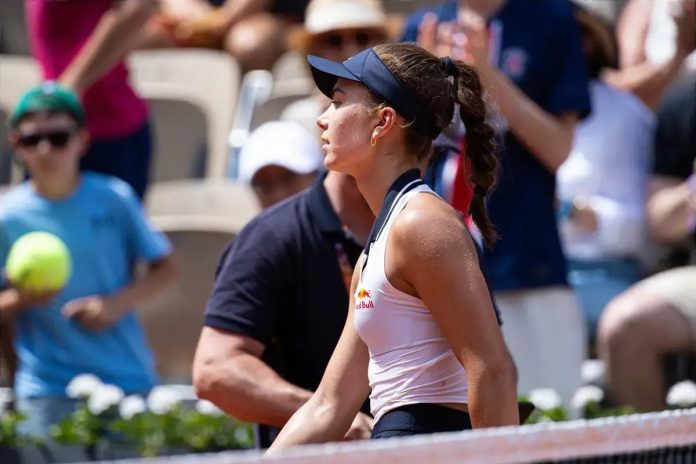
The suffocating heat that has marked this edition of the French Open has once again sparked controversy, this time with an incident that ignited the atmosphere in Paris. At the center of the controversy was Serbian player Iva Jovic, who, after two intense sets in extremely high temperatures, requested a change of clothes before the third set of her match against Naomi Osaka. However, the chair umpire denied her request, triggering a heated debate about the rules and fairness in women’s tennis.
“She has to be ready to play. She is counting her time. If she comes back after her and the court is ready, she will be penalized for a time violation,” the umpire stated, a response that left Jovic perplexed. The tennis player insisted, asking if she could go to the bathroom, which could justify the change of clothes, but the umpire remained firm: “It’s the same thing, she has to be ready to play before her.” The pressure mounted, given that Osaka had already taken her break, while Jovic had only used the rest period after the first set.
This decision by the referee sparked a wave of indignation and questions, particularly because Jovic’s request was legitimate given the extreme conditions. The ITF regulations clarify that each player is entitled to one authorized break per match, which can be used to go to the bathroom, change clothes, or both, with a maximum limit of five minutes. However, the application of the rules often reveals a double standard: male players are frequently seen changing clothes during breaks without facing any penalties, raising concerns about equality of treatment in sports.
This episode left an unexpected mark on a duel that promised to be epic. Jovic, who two years ago was ranked only 206th in the world, engaged in a battle lasting almost three hours against the world’s 17th-ranked player, Naomi Osaka, in a clash between two of the most powerful hitters in the game. The match was tense, reflecting the closeness of their rankings: Osaka won the first set in a tiebreak, 7-5; Jovic responded with a triumph in the second set, also in a tiebreak, 7-3; the decision came down to the third set, where Osaka broke her opponent’s serve at 5-4 and closed the match at 6-4. Only four points separated the two throughout the game, a minimal margin that could have swung either way.
About her opponent’s performance, Osaka did not hold back on her praise: “She is an incredible player. It was the first time I played against her and I’m sure she will go far in Grand Slams.” The victory secured Osaka her first appearance in the second week of Roland Garros, where she will face the toughest possible opponent: world number one Aryna Sabalenka, who has already defeated her twice in 2026.
When asked about this upcoming challenge, Osaka appeared calm and determined: “I didn’t know we would meet again. YOLO, whatever happens. I feel like I played well against her in Madrid, although I dropped my level in the second and third sets. I hope to maintain consistency and stay aggressive. Whatever happens, will happen.” The head-to-head record is in favor of Sabalenka, who leads 2-1 this year, including victories at Indian Wells and Madrid, the latter after coming back from a set down.
Sabalenka, who eliminated Daria Kasatkina to reach this match, also showed she is ready for battle: “The last match in Madrid was very balanced and of a high level. She raised her level. I am ready to fight and do everything to win.” Despite the age difference of only seven months between them, their career peaks have not fully coincided, with Osaka winning four Grand Slams between 2018 and 2021, while Sabalenka has yet to advance past the quarter-finals in a major.
Now, in Paris, the paths of these two stars cross at one of the most decisive moments of the tournament. For Osaka, who is making her debut in the second week of Roland Garros, all the strength and grit she demonstrated against Jovic will be necessary to try to defeat the world number one and advance further in the competition. The controversy over the ban on changing clothes during the match is just another chapter in this intense drama that women’s tennis continues to provide.
This article first appeared on Apito Final.
Discover more from Apito Final
Subscribe to get the latest posts sent to your email.

