


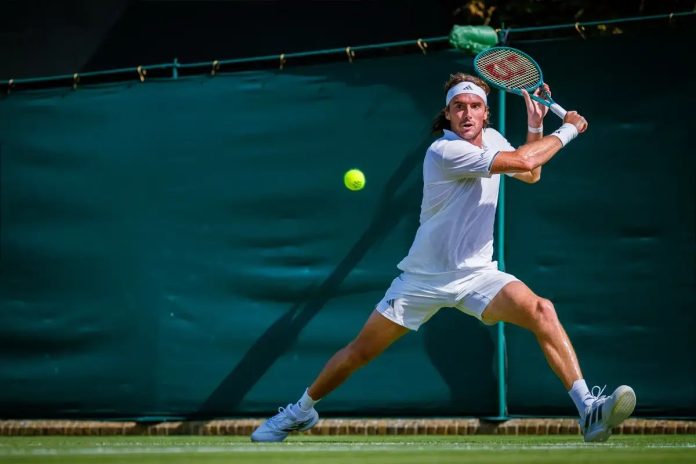
Daniil Medvedev did not hide his aversion to the transition between surfaces, making impactful statements right after his emphatic victory against Marin Cilic in his debut at Wimbledon 2026. The Russian, known for his frankness off the court, surprised again by analyzing the pitfalls of grass, confessing a visceral hatred for the change in surface and making a bold prediction about the future of Stefanos Tsitsipas, despite the Greek's unstable moment.
The current world number five dispatched Cilic with authority on one of the main courts at the All England Club, displaying impressive solidity in his movements and during rallies. However, Medvedev did not hold back in his comments about the difficulties that grass imposes even on the best in the world. “It's not easy to move on grass. In fact, I don't think I'm among the best. We see Jannik Sinner sliding around and it looks like he never gets injured. If I tried to do the same, I would probably end up injured. We've seen several players get hurt on this surface and, clearly, it's not ideal. Today I managed to move very well and I think that was the key to the match. I worked a lot with my fitness coach to adapt my movements and my tennis to the grass,” the Russian explained at the end of the match.

THE 2026 WORLD CUP IS EXPERIENCED WITH LEGO
O MUNDIAL 2026 VIVE-SE COM A LEGO
Medvedev also highlighted the importance of serving in this context: “On all surfaces, tactics matter, but on grass, serving is even more decisive. You can play an extraordinary match and still lose. On clay or hard courts, if you are clearly superior to your opponent in several aspects, you usually win. Here, it’s different. Your opponent can be inferior for much of the match, serve really well, reach the tie-break, and beat you.”
The Russian tennis player went even further by admitting that the transition period from clay to grass is one of the most complicated times of the season. “I will be honest: I hate changing surfaces. That’s why I always try to play a tournament before [Wimbledon](https://apitofinal.pt/modalidades/tenis/luciano-darderi-eliminado-na-primeira-ronda-de-wimbledon-por-ethan-quinn/). I know that the first tournament on grass is always very difficult and, normally, I play much better in the second one or even here,” Medvedev admitted, with a disarming honesty that few colleagues dare to show.
When asked about the delicate moment that [Stefanos Tsitsipas](https://apitofinal.pt/modalidades/tenis/djokovic-supera-wu-yibing-e-segui-para-a-segunda-ronda-em-wimbledon/) is going through, following yet another professional separation from his father and coach Apostolos, Medvedev did not hesitate to express complete confidence in the Greek's potential for recovery. “I saw the news yesterday. [You](https://apitofinal.pt/internacional/dez-penaltis-falhados-marcam-recorde-historico-no-mundial-2026/) never know what will happen, but when a player has already shown that level, it means that quality is still there. I wouldn’t be surprised at all if, in two weeks, a year, or even five, he won a [Grand Slam](https://apitofinal.pt/modalidades/tenis/alcaraz-prepara-regresso-a-competicao-apos-lesao-no-pulso-direito/) or reached a semi-final. He has a great serve, an extraordinary forehand, and excellent volleys. It is evident that he is going through a complicated phase and has had difficulties with his tennis, but I wouldn’t be surprised if, suddenly, he found the right path again and accumulated a series of great results,” Medvedev argued, making it clear that he dismisses narratives of premature decline for Tsitsipas.
Regarding the increase in physical issues on the circuit, the Russian was emphatic: “Today everyone hits very hard and moves very well. Everyone is trying to improve continuously, and when you train so much and play consecutive weeks, it’s normal for overload injuries to occur. Fortunately, medicine has also evolved immensely, and now we have much better tools than we did twenty years ago,” the player analyzed, emphasizing the brutal physical demands of modern tennis.
Medvedev's convincing victory not only reinforces his status as a contender at Wimbledon, but also sends a warning to his rivals: the Russian is determined to adapt to grass, despite his stated discomfort. His candid testimony about the challenges of the surface and injuries makes it clear that to succeed in London, talent alone is not enough – physical and mental resilience are essential.
For Tsitsipas, Medvedev's words can serve as a motivational tonic at a time when the Greek player is looking to reinvent himself after yet another family and technical breakdown. The circuit is watching closely: can Tsitsipas surprise at this Wimbledon, or will he disappoint once again in the face of such expectations? For now, Medvedev advances confidently on the London grass, but he does not hide the fact that the true Wimbledon is also played off the court, in the ability to adapt, overcome, and survive the toll of an exhausting season. The next round promises drama and intensity, in a tournament where the unpredictability of the grass finds no parallel in the character and ambition of its protagonists.
NOW YOU CAN FOLLOW THE FOOTBALL WORLD CUP WITH ALL THE INFORMATION – HERE
Discover more from Apito Final
Subscribe to get the latest posts sent to your email.

