


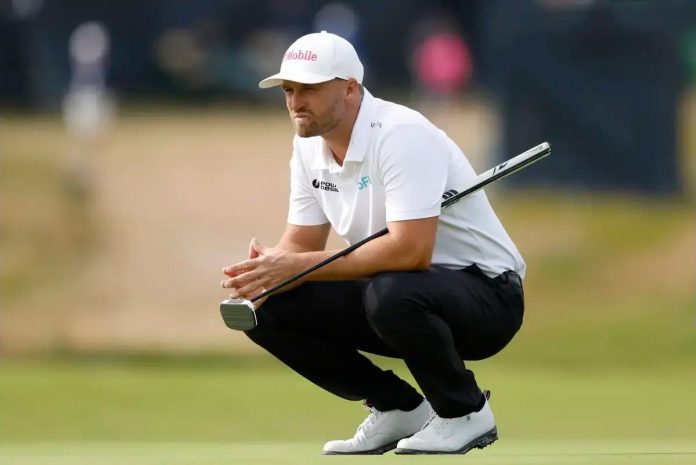
Wyndham Clark was one step away from tying the course record at Shinnecock, with an impressive 64 (-6), but Friday morning was marked by an unexpected controversy: the American’s group was officially warned for slow play, reigniting the debate over sluggishness in elite golf. The USGA intervened unequivocally at the U.S. Open, demanding that Clark, Dustin Johnson, and Gary Woodland speed up after they fell five minutes behind the scheduled tee time – an incident that left many fans and players watching closely the immediate future of the tournament.
Clark, the defending champion, stood out in the first round with a solid performance, finishing just one stroke behind Tommy Fleetwood’s record. However, during Friday’s round, his group was called out by John Wood, a former caddie and now commentator, who reported live: “The USGA officials told them to pick up the pace on the ninth hole as they were five minutes behind. They asked them to speed up and they were already making up time.” The warning coincided with Clark’s first bogey of the day, while Woodland made a birdie and Johnson secured par. The incident did not provoke protests, unlike what has happened in recent tournaments, but highlighted that the pressure on the pace of play is increasing.

THE 2026 WORLD CUP IS EXPERIENCED WITH LEGO
The USGA has become increasingly strict in its fight against slow play, a hot topic on international circuits. This year, the governing body of North American golf partnered with T-Mobile to debut technology that allows for real-time decisions, drastically reducing delays and bringing greater rigor to rule enforcement. At the U.S. Women’s Open, for example, an innovative policy was introduced: each player has 40 seconds to execute their shot after it is their turn, with progressive penalties – from stroke loss to possible disqualification if delays persist. It is not yet confirmed whether the same policy is fully implemented at Shinnecock, but the warning to Clark and company makes it clear that there will be no complacency.
The context could not be more sensitive: the USGA wants to avoid at all costs that the second round spills over into the so-called “moving day,” intensifying the pressure on the players. It is worth recalling that just a month ago, Justin Thomas’s group was also warned for slow play at the 2025 PGA Championship. At the time, Thomas defended himself, saying: “We weren’t holding up the group behind us. We made up for it right on the next hole, but the conditions at Aronimink required more consideration.” The case reignited the debate, now replicated at Shinnecock, about the extent to which course conditions justify a slower pace – and whether the enforcement of the rule should be more flexible.
Clark, for his part, felt the weight of the moment when he missed a 14-meter birdie putt on the ninth and then missed a one-meter par putt, suffering a bogey that reduced his lead. Despite this, he responded with two birdies on holes 12 and 13, regaining the lead with a four-stroke advantage. Dustin Johnson, known for his quick play but also for his meticulous reading of the greens alongside his brother-caddie Austin, had a morning to forget: after a double bogey on the 11th, he added two consecutive bogeys and a disastrous quadruple bogey on the 15th, dropping to 55th place. Woodland, in turn, could only manage 12th place, remaining outside the top 20 in Majors since 2023.
Thursday was marked by a frenetic pace – Johnson strung together four consecutive birdies, and Clark shone with a birdie-birdie-eagle sequence before nightfall. However, Friday brought a more tense atmosphere and a forced slower pace, under the watchful eyes of the officials.
At this moment, Clark remains firmly in the lead, but the public warning makes it clear that the USGA will not hesitate to impose penalties if the pace slows down again. With the competitive landscape heating up and the rules becoming increasingly strict, a weekend of intense emotions is anticipated, where every second could make the difference between glory and disappointment. The fight against slow play promises to continue shaking up the world of golf and could even determine the outcome of this historic U.S. Open.
NOW YOU CAN FOLLOW THE WORLD CUP WITH ALL THE INFORMATION – HERE
Discover more from Apito Final
Subscribe to get the latest posts sent to your email.

