


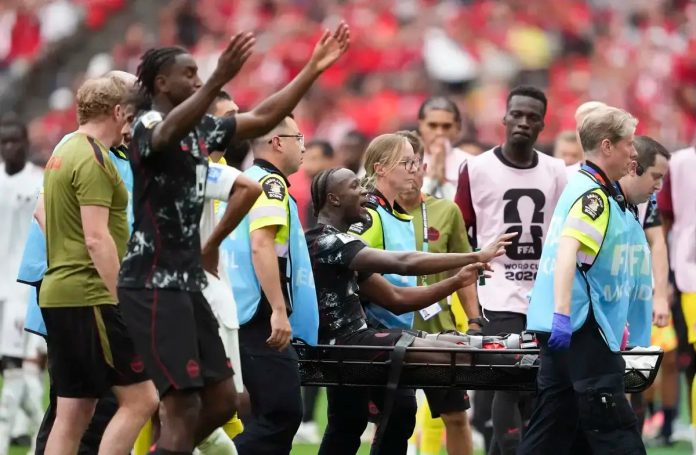
A crack of bone drowned out the roar of 52,497 fans at BC Place and cast a shockwave over the most historic night in Canadian football. Canada, the host of the World Cup, had just secured its first-ever victory in the tournament — a memorable 6-0 thrashing of Qatar — but the joy was quickly devastated by a chilling injury to star midfielder Ismaël Koné. The image of the 22-year-old’s leg hanging unnaturally marked all those present and transformed ecstasy into concern and disbelief.
The match, held in Vancouver, was meant to be a celebration of the meteoric rise of Canadian football, but it was marred by Koné’s misfortune in the 51st minute. At a time when Canada was already leading 4-0, the midfielder fell victim to a brutal and unnecessary challenge from Assim Madibo, who, after having seen a compatriot sent off, left Qatar reduced to nine players. The silence that descended upon the stadium was only broken by the cries of teammates and the chant of Koné’s name as he was carried off on a stretcher, still waving to the fans.
THE 2026 WORLD CUP COMES ALIVE WITH LEGO
The severity of the injury was quickly confirmed: an open fracture, an immediate end to the World Cup for Koné, and an emergency operation just hours later. His teammates visited him in the hospital as soon as they were allowed, aware that they had lost not only one of the most creative midfielders but also the heart of the locker room, the one responsible for good vibes and even the music. Coach Jesse Marsch revealed the extent of the impact: “We heard the crack,” he said, describing the moment he gathered the entire team during a hydration break to try to mentally reorient the group. “Everyone was shaken by the nature of the injury and what Ismaël represents for us. It’s going to be a huge loss… but even in pain, he managed to calm everyone around him. That says everything about him as a person.”
Alistair Johnston, the starting defender, relived an old nightmare: “It sounded like a gunshot,” he recalled after the game, visibly emotional. “I looked and saw the entire bench jumping up, then I realized the angle at which his leg was positioned… that’s when everything crashes down on you.” Johnston remembers that two years ago, during the preparation for the Copa América, a similar incident sidelined Tajon Buchanan before the first game. At that time, the tragedy served as a catalyst for one of Canada’s best campaigns ever. “It’s very hard to see one of your brothers fall, but if we needed more motivation for this World Cup, now we have it,” the defender emphasized.
Despite the dramatic episode, Canada’s performance was absolutely devastating. Jonathan David scored two goals by halftime, matching the total number of goals scored by the men’s national team in 44 years of World Cup history within just 45 minutes. The forward would go on to complete a historic hat-trick, becoming the first player from a host nation to achieve this since 1964. Nathan Saliba, called up on short notice to replace Koné, did not let the pressure get to him and scored a direct free kick on his World Cup debut. “I didn’t think I would be able to control my emotions, but I had to. It’s like throwing someone into the sea and expecting them to learn how to swim,” Saliba confessed, still processing the surreal night.
Canada not only dispatched Qatar with a display of pure efficiency, but also sent a clear signal to the world: it is ready to compete at the highest level, even in the face of extreme adversity. Jonathan David, nicknamed the “Iceman” for his coolness, responded to critics who questioned his form after a less successful game against Bosnia and Herzegovina, proving that he is a striker for the big stage.
Now, without Koné, Canada faces a new challenge: maintaining momentum and emotional cohesion in a competition where every detail matters. Coach Jesse Marsch will need to reinvent the midfield and quickly find alternatives to fill the void left by his playmaker. The group appears more united than ever, with the promise to “fight for Koné” serving as extra fuel for the upcoming matches. A group stage that was expected to be complicated now looks more manageable after this result and this moral response, bringing Canada to the brink of an unthinkable achievement just a few years ago: advancing to the knockout stage of a World Cup at home. Canadian football is writing a new history — and it does so with courage, talent, and a spirit of resilience that has already won over the country.
NOW YOU CAN FOLLOW THE WORLD CUP WITH ALL THE INFORMATION – HERE
Discover more from Apito Final
Subscribe to get the latest posts sent to your email.

